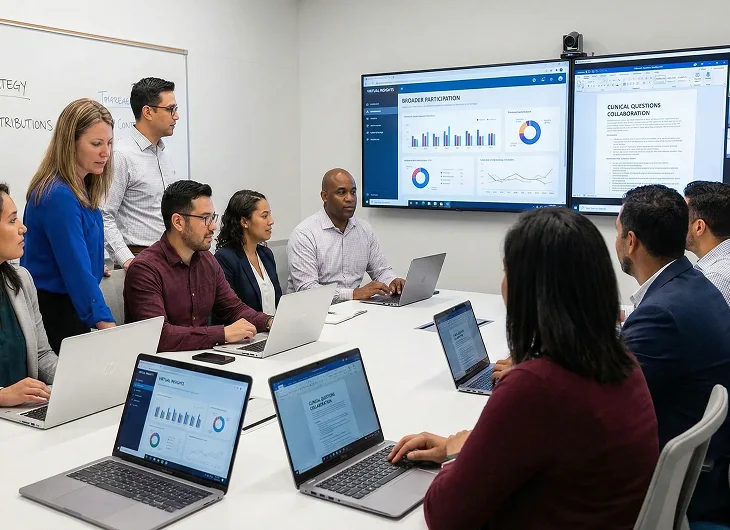
Virtual Advisory Boards

Virtual Advisory Boards

MphaR Our Services Virtual Advisory Boards
Virtual Advisory Boards (VABs) provide a flexible, efficient, and insight-rich way to engage experts across geographies. MphaR supports the full design, coordination, and delivery of virtual advisory engagements —ranging from live, synchronous sessions to fully asynchronous formats—ensuring meaningful scientific dialogue and high-quality outcomes.
Our approach enables companies to gather deeper, more diverse insights while eliminating logistical constraints and enhancing global participation.

Get Some Ideas for Creating a Perfect Event

Live Virtual Advisory Boards

Real-time meetings that allow direct discussion, debate, and interactive exchange between advisors and moderators.

Asynchronous Virtual Advisory Boards (AVAB)

Structured online discussions that run continuously over several days or weeks—allowing advisors to contribute thoughtfully, at their own pace, from anywhere in the world.

Hybrid / Mixed Approach

Our MphaR Virtual Advisory Board Platform combines synchronous and asynchronous components, offering the best of both worlds.

This blended model supports more meaningful, reflective contributions and increases overall engagement.

The MphaR Virtual Advisory Board Platform

Our proprietary digital platform is designed specifically for scientific engagement, giving Medical Affairs teams a secure, compliant, and highly interactive environment for virtual advisory activities.

Platform Features :

  • Discussion forums for structured, topic-based dialogue 
  • Breakout sessions for small-group expert discussions 
  • Live video calls integrated directly into the platform 
  • Interactive workshops for collaborative analysis and problem-solving 
  • Polling & surveys to quantify opinions and generate evidence-driven insights 
  • Document annotation & co-creation tools for reviewing manuscripts, slides, and publications 
  • Meeting board functionality allowing real-time idea sharing, prioritization, and clustering 

24/7 Expert Engagement

Advisors and moderators can participate anytime, anywhere, with: 

Designed for Deeper, More Meaningful Insights

Virtual engagement encourages:
  • Reflection and more nuanced contributions
  • Broader participation from experts with limited travel availability
  • Real-time collaboration on documents, data, and clinical questions
  • A higher volume of insights than traditional in-person-only boards

Wide Stakeholder Inclusion

Our Virtual Advisory Boards can include a diverse set of stakeholders, such as:
  • Physicians
  • Pathologists
  • Pharmacists
  • Clinical pharmacologists
  • Nurses / Advanced Practice Providers (APPs)
  • Government officials
  • Patient Advocacy Groups (PAGs)
This ensures multidisciplinary perspectives are captured for a more complete, real-world view.

Case Studies

Planned F2F Advisory Board on Non-Small Cell Lung Cancer (NSCLC) Switched to Virtual Format

Top-Notch Advisory Board in Metastatic Breast Cancer Executed in Virtual Format

Hemophdia a Virtual Advisory Board with Patient Advocacy (PAGS)

Virtual Advisory Board with Payers

Improving the Treatment Care of Patients with Multiple Myeloma Through Regular Connection between International and National Rheumatologists in…

NSCLC Virtual Advisory Board with Global Oncologists

What Makes Our Strategy Support Unique?

What HCPs and Medical Affairs Experts Tell About Working with Us

We work closely with HCPs and Medical Affairs experts worldwide. Here’s what they share about partnering with MphaR
Trusted by Industry Leaders

Medical Affairs Trends: Blog, Digest and Podcasts

Stay informed on emerging Medical Affairs trends with expert blog articles, and twice-monthly editions of our Medical Affairs Digest and podcasts series.

TrendWatch: Medical Affairs

Explore concise articles covering the latest trends and innovations in Medical Affairs

Latest Article

AI in Action: How Medical Affairs Is Turning Data Into Real Insights

The article explains how artificial intelligence is transforming insight generation within Medical Affairs, shifting it from a labor-intensive, retrospective process into a rapid, intelligence-driven capability. As the volume of scientific information from congresses, publications, real-world evidence, and field interactions continues to grow, AI technologies—including natural language processing and machine learning—enable the rapid categorization, synthesis, and prioritization of complex datasets at scale. By enhancing capabilities such as literature triage, trend detection, and cross-source insight integration, AI allows Medical Affairs teams to uncover emerging themes, identify evidence gaps, and generate actionable insights with greater speed and precision. Supported by structured data integration, automated workflows, and predictive analytics, insight generation evolves from a manual reporting task into a proactive, strategic function. Despite challenges related to data quality, governance, and validation, the integration of AI positions Medical Affairs as a central driver of evidence-based decision-making, continuous learning, and more agile scientific strategy.

From Protocol to Patient: The Evolving Partnership Between Medical Affairs and Clinical Operations-Powered by MSLs and AI

The article explains how clinical development is evolving from a siloed, linear process into a dynamic, integrated system driven by collaboration between Medical Affairs and Clinical Operations. As trial complexity increases due to precision medicine, regulatory demands, and patient-centric expectations, early scientific input and continuous feedback become critical. Medical Affairs, supported by MSLs, shifts upstream to shape protocol design, inform feasibility, and integrate real-world insights, while AI enables rapid data analysis, predictive planning, and real-time trial optimization. By combining MSL-driven field intelligence with AI-powered analytics, organizations create continuous insight loops that enhance site selection, patient recruitment, and trial execution. Supported by shared goals, digital platforms, and cross-functional governance, clinical trials transform from isolated studies into adaptive, insight-driven ecosystems. Despite challenges around alignment, role clarity, and AI adoption, this integrated model positions Medical Affairs and Clinical Operations as co-drivers of more efficient, patient-centered trials and stronger evidence generation.

From Data to Decisions: AI’s Impact on Real-World Evidence in Medical Affairs

The article explains how artificial intelligence is transforming the generation and application of real-world evidence within Medical Affairs, shifting it from a complex, data-heavy process into a streamlined, insight-driven function. As real-world data from diverse sources such as EHRs, claims, and patient-reported outcomes continues to expand, AI technologies—including machine learning and natural language processing—enable the structuring, analysis, and interpretation of fragmented datasets at scale. By enhancing capabilities in areas such as safety signal detection, patient journey mapping, and comparative effectiveness research, AI allows Medical Affairs to generate deeper, more representative insights that reflect real clinical practice. Supported by improved data standardization, predictive analytics, and cross-functional collaboration, RWE evolves from a retrospective exercise into a proactive, strategic asset. Despite challenges related to data quality, bias, and regulatory acceptance, the integration of AI positions Medical Affairs as a central driver of evidence-based decision-making, continuous insight generation, and patient-centered healthcare innovation.

Bi-monthly Newsletter: Medical Affairs Digest

Your bi-monthly overview of essential Medical Affairs updates and emerging industry signals

Latest Newsletter
Bi-Monthly podcasts: Medical Affairs Voices

Listen to expert conversations exploring current trends and future directions in Medical Affairs

Precision Medicine in Oncology: Transforming Cancer Diagnostics Using AI Tools

In this episode, we uncover how artificial intelligence is transforming oncology, marking a shift from standardizedtreatments to precision medicine tailored to each patient’s genetic and molecular profile. From AI-powered imaging and digital pathology to genomic analysis and liquid biopsies, technology is reshaping how cancer is detected, understood, and treated. Hear how these innovations are driving earlier diagnoses, improving treatment accuracy, and empowering clinicians with insights once thought impossible. We also explore the ethical and practical challenges of integrating AI into cancercare and what it means for patients and providers alike. Join us as we look ahead to a future where AI doesn’t replace the human touch—it amplifies it, bringing us closer to truly personalized oncology care.

Leveraging AI and NLP to Transform Medical Information Systems in Medical Affairs

In this episode, we explore how artificial intelligence and natural language processing are reshaping how Medical Affairs teams manage, interpret, and apply vast volumes of unstructured medical information. From scientific literature and safety reports to advisory board insights and field intelligence, NLP is turning free text into structured, actionable knowledge—helping teams move faster while maintaining scientific rigor. Discover how NLP is being applied across literature intelligence, medical information systems, pharmacovigilance, and stakeholder engagement, and why human oversight remains essential in regulated medical environments. We also examine the risks, ethical considerations, and governance frameworks needed to ensure accuracy, transparency, and compliance. Join us as we look ahead to the evolution from language processing to true language understanding—and what this shift means for the future of Medical Affairs as a strategic, insight-driven function.

From Data to Dialogue — Strengthening Patient-Centricity Through Virtual Advisory Boards

In this episode, we examine how Virtual Advisory Boards are revolutionizing patient engagement, turning static data into meaningful dialogue that shapes real-world decisions. As patient-centricity becomes a defining principle in modern pharma, digital platforms are creating space for authentic collaboration between patients, caregivers, and industry leaders. Discover how virtual formats remove barriers to participation, ensure inclusivity, and make continuous patient input a practical reality. We’ll explore how the MphaR Virtual Advisory Board platform enables companies to integrate patient insights into trial design, treatment strategies, and beyond. Tune in as we explore how the future of patient engagement is being built—one conversation at a time—through innovation, empathy, and dialogue that truly puts patients at the center of healthcare.

Follow MphaR on Social Media:

MphaR Our Services Virtual Advisory Boards

FAQs

Yes, this is one of the most requested deliverables? We also facilitate the session if needed.
In urgent cases, 2-3 weeks. Standard timelines: 8-12 weeks.
Yes. We provide structured insights. Key takeaways and recommended actions are clearly highlighted.
×

Thank you! Your message has been sent.

    Get Case Study

    Improving the treatment care of patients with Multiple Myeloma through regular digital connection between International, National Experts and haematologists in Europe

      Get Brochure