Clinical Trials Partnership and Support

Clinical Trials Partnership and Support

MphaR Our Services Clinical Trials Partnership and Support

At MphaR, we provide comprehensive scientific expertise to strengthen every stage of your clinical trial—from early protocol development to effective collaboration with investigators and key opinion leaders. Our team of medical experts, scientific writers, and clinical specialists ensures your studies are strategically designed, scientifically sound, and executed with excellence.

Scientific Support in Clinical Trials

1. Steering Committees

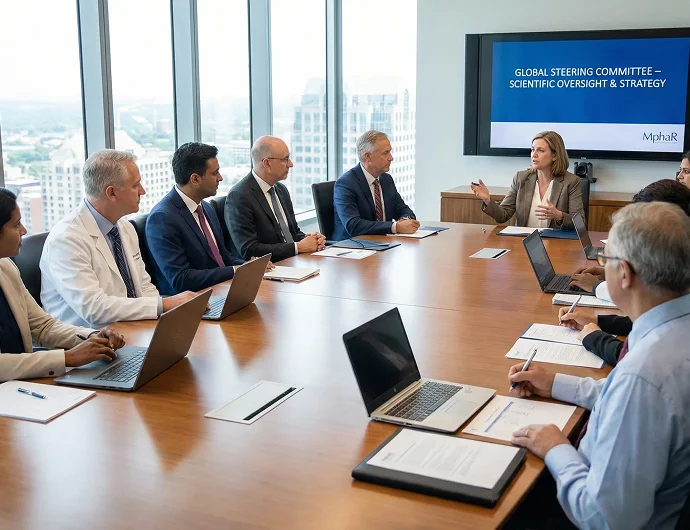
We establish and manage highly qualified steering committees composed of global experts who provide scientific oversight, strategic advice, and critical decision-making throughout the study. MphaR facilitates all operations—from expert identification to meeting moderation—ensuring that your clinical development plan benefits from evidence-driven guidance and broad scientific alignment.

2. Investigator’s Meetings

We organise and deliver impactful investigator meetings that clearly communicate study objectives, operational expectations, and scientific rationale. Our team supports agenda creation, presentation development, live facilitation, and post-meeting follow-up to ensure site teams are aligned, engaged, and fully prepared for trial execution.

3. Protocol Writing

Our scientific writers develop clear, compliant, and robust clinical trial protocols tailored to your therapeutic area and study objectives. We ensure the protocol communicates the scientific rationale, methodology, patient pathways, and operational considerations in a way that supports regulatory approval and site implementation.

4. Protocol Assessment with KOLs

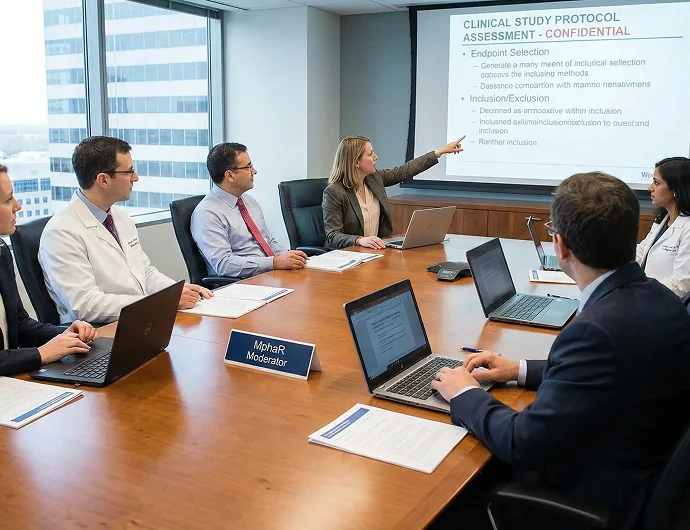
MphaR coordinates structured scientific reviews of your protocol with leading key opinion leaders. Their insights help refine study design, endpoint selection, inclusion/exclusion criteria, and feasibility. This early expert input strengthens study relevance, operational feasibility, and scientific credibility.

5. ISL Support

Our Investigator Science Liaisons (ISLs) serve as your scientific ambassadors, supporting trial sites with accurate information, addressing scientific questions, and fostering strong relationships between investigators and sponsors. ISL support enhances site engagement, encourages better recruitment performance, and ensures consistent scientific communication across regions.

6. Target Right Clinical Sites with MphaR Report

MphaR prepares tailor-made clinical site intelligence reports to support informed site selection and trial planning. Based on your specific disease area and study needs, our reports identify high-performing clinical sites with proven enrollment success in similar trials, highlight sites with competitive recruitment capabilities, and provide quality assessments informed by regulatory inspection history. This data-driven approach helps sponsors optimize site selection, reduce risks, and accelerate study

What HCPs and Medical Affairs Experts Tell About Working with Us

We work closely with HCPs and Medical Affairs experts worldwide. Here’s what they share about partnering with MphaR

Trusted by Industry Leaders

Medical Affairs Trends: Blog, Digest and Podcasts

Stay informed on emerging Medical Affairs trends with expert blog articles, and twice-monthly editions of our Medical Affairs Digest and podcasts series.

TrendWatch: Medical Affairs

Explore concise articles covering the latest trends and innovations in Medical Affairs

Latest Article

From Protocol to Patient: The Evolving Partnership Between Medical Affairs and Clinical Operations-Powered by MSLs and AI

The article explains how clinical development is evolving from a siloed, linear process into a dynamic, integrated system driven by collaboration between Medical Affairs and Clinical Operations. As trial complexity increases due to precision medicine, regulatory demands, and patient-centric expectations, early scientific input and continuous feedback become critical. Medical Affairs, supported by MSLs, shifts upstream to shape protocol design, inform feasibility, and integrate real-world insights, while AI enables rapid data analysis, predictive planning, and real-time trial optimization. By combining MSL-driven field intelligence with AI-powered analytics, organizations create continuous insight loops that enhance site selection, patient recruitment, and trial execution. Supported by shared goals, digital platforms, and cross-functional governance, clinical trials transform from isolated studies into adaptive, insight-driven ecosystems. Despite challenges around alignment, role clarity, and AI adoption, this integrated model positions Medical Affairs and Clinical Operations as co-drivers of more efficient, patient-centered trials and stronger evidence generation.

From Data to Decisions: AI’s Impact on Real-World Evidence in Medical Affairs

The article explains how artificial intelligence is transforming the generation and application of real-world evidence within Medical Affairs, shifting it from a complex, data-heavy process into a streamlined, insight-driven function. As real-world data from diverse sources such as EHRs, claims, and patient-reported outcomes continues to expand, AI technologies—including machine learning and natural language processing—enable the structuring, analysis, and interpretation of fragmented datasets at scale. By enhancing capabilities in areas such as safety signal detection, patient journey mapping, and comparative effectiveness research, AI allows Medical Affairs to generate deeper, more representative insights that reflect real clinical practice. Supported by improved data standardization, predictive analytics, and cross-functional collaboration, RWE evolves from a retrospective exercise into a proactive, strategic asset. Despite challenges related to data quality, bias, and regulatory acceptance, the integration of AI positions Medical Affairs as a central driver of evidence-based decision-making, continuous insight generation, and patient-centered healthcare innovation.

Co-Creating the Future: Medical Affairs and Patient Associations as Equal Partners

The article examines how the role of patients—and increasingly organized patient associations—is evolving from passive recipients of care to active partners in scientific dialogue, education, and evidence generation. As patient‑centricity becomes central to healthcare innovation, Medical Affairs is uniquely positioned to facilitate meaningful, two‑way collaboration with patient communities. Enabled by digital technologies, this shift moves engagement beyond one‑way communication toward co‑creation, where patient insight informs educational content, research priorities, and strategic decision‑making. By embracing transparency, structured collaboration, and shared ownership, Medical Affairs can integrate lived experience into scientific and operational processes. This evolving partnership model positions patient collaboration not only as an ethical imperative, but as a strategic advantage for creating more relevant evidence, impactful education, and ultimately better patient outcomes.

Bi-monthly Newsletter: Medical Affairs Digest

Your bi-monthly overview of essential Medical Affairs updates and emerging industry signals

Latest Newsletter
Bi-Monthly podcasts: Medical Affairs Voices

Listen to expert conversations exploring current trends and future directions in Medical Affairs

Precision Medicine in Oncology: Transforming Cancer Diagnostics Using AI Tools

In this episode, we uncover how artificial intelligence is transforming oncology, marking a shift from standardizedtreatments to precision medicine tailored to each patient’s genetic and molecular profile. From AI-powered imaging and digital pathology to genomic analysis and liquid biopsies, technology is reshaping how cancer is detected, understood, and treated. Hear how these innovations are driving earlier diagnoses, improving treatment accuracy, and empowering clinicians with insights once thought impossible. We also explore the ethical and practical challenges of integrating AI into cancercare and what it means for patients and providers alike. Join us as we look ahead to a future where AI doesn’t replace the human touch—it amplifies it, bringing us closer to truly personalized oncology care.

Leveraging AI and NLP to Transform Medical Information Systems in Medical Affairs

In this episode, we explore how artificial intelligence and natural language processing are reshaping how Medical Affairs teams manage, interpret, and apply vast volumes of unstructured medical information. From scientific literature and safety reports to advisory board insights and field intelligence, NLP is turning free text into structured, actionable knowledge—helping teams move faster while maintaining scientific rigor. Discover how NLP is being applied across literature intelligence, medical information systems, pharmacovigilance, and stakeholder engagement, and why human oversight remains essential in regulated medical environments. We also examine the risks, ethical considerations, and governance frameworks needed to ensure accuracy, transparency, and compliance. Join us as we look ahead to the evolution from language processing to true language understanding—and what this shift means for the future of Medical Affairs as a strategic, insight-driven function.

From Data to Dialogue — Strengthening Patient-Centricity Through Virtual Advisory Boards

In this episode, we examine how Virtual Advisory Boards are revolutionizing patient engagement, turning static data into meaningful dialogue that shapes real-world decisions. As patient-centricity becomes a defining principle in modern pharma, digital platforms are creating space for authentic collaboration between patients, caregivers, and industry leaders. Discover how virtual formats remove barriers to participation, ensure inclusivity, and make continuous patient input a practical reality. We’ll explore how the MphaR Virtual Advisory Board platform enables companies to integrate patient insights into trial design, treatment strategies, and beyond. Tune in as we explore how the future of patient engagement is being built—one conversation at a time—through innovation, empathy, and dialogue that truly puts patients at the center of healthcare.

Follow MphaR on Social Media:

MphaR Our Services Clinical Trials Partnership and Support

FAQs

Absolutely. Many partners send us their existing plan, and we strengthen the objectives, KPIs, tactics, and cross-functional alignment.
Yes. We often work with incomplete pipelines and help map the evidence gap and realistic timelines.
×

Thank you! Your message has been sent.

    Get Case Study

    Improving the treatment care of patients with Multiple Myeloma through regular digital connection between International, National Experts and haematologists in Europe

      Get Brochure